
Cases end in one of two ways.
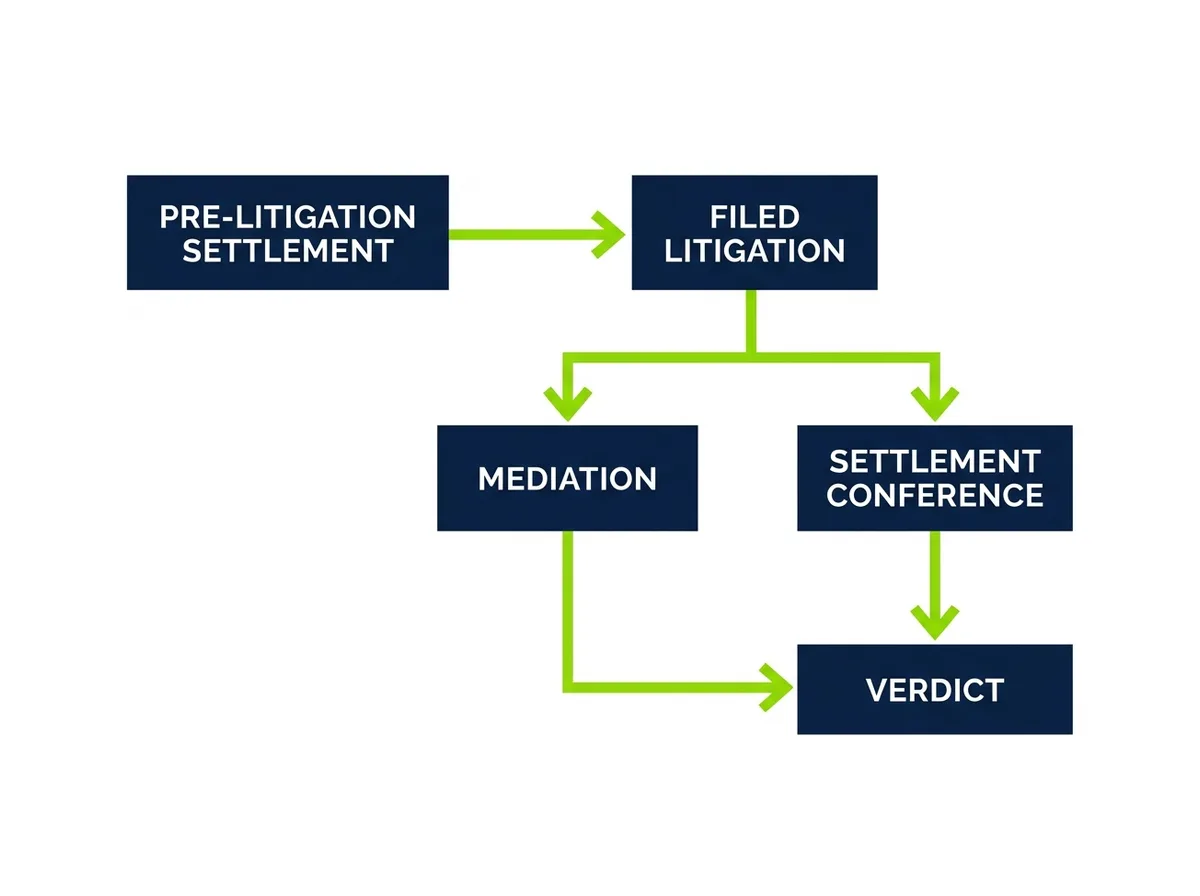
They get resolved when an offer is made that is within the case's value. Or they get resolved by a verdict, which means both parties disagree, there is no meeting of the minds, there is nothing left to negotiate over, and there are twelve people who decide what the case is worth. Not unanimously, either. A civil verdict in California takes nine of those twelve, which is a different calculation from the criminal cases people have seen on television.
Between those two poles is most of what people mean when they ask how long this takes.
Filing a Lawsuit Is Not the Same as Going to Trial
A car accident case can settle before a lawsuit is ever filed. That would be a pre-litigation settlement.
Filing a lawsuit starts litigation. But in many cases, after litigation has started, after a judge has been assigned, after the lawyers have gone to court on the case, they still settle down the road through mediation or mandatory settlement conferences, or because the lawyers come to an agreement later.
This is the point that relieves people most when they hear it.
Just because your case has gone to court doesn't mean you, as the client, will be in court. Your lawyer will handle court dates and related matters. So your case can be in court, you can have a case number, you can have a straight-up lawsuit, and it doesn't mean you as the client will be on the stand in front of a panel of jurors.
Your case can be in litigation while your involvement stays roughly what it was. The lawyer handles the appearances. Fear of testifying keeps people from filing cases that should be filed, and it is usually a fear about something that will not happen.
When Cases Settle
Cases settle when they are ready. They settle when the offer is right, or when the offer is right relative to the problems a case has.
That second clause is doing real work. Every case has problems. Liability might be contested. There might be a treatment gap. A witness might be unhelpful. The value of a case is not its value in a perfect world; it is its value given what is actually in the file.
It is the lawyer's job to explain both sides of the case to the client. These are the real risks associated with this case and with continuing on. And on the flip side, this is the real risk of settling for this amount, given everything you have coming in the future.
If you are a lawyer, you are a counselor, you are an advisor, you are all these different things. The decision belongs to the client, and the job is to make sure it is made with both risks in view.
Venue Changes Strategy
Where a case is filed matters, and it matters in a way that is not obvious from outside the practice.
Throughout California, there are different demographics, meaning historical outcomes vary across the state and even within Los Angeles. That is why lawyers in the firm will say that a location is a great venue for us, an okay venue, or a problem venue. A lot of that depends on what the case is about and where it sits.
Long Beach, California, is historically a place where people are willing to go to trial, specifically plaintiffs' lawyers, because they believe justice can be achieved there. A different county carries a different history. Your lawyer should know the difference, because the venue shapes what the other side believes about its own exposure, which feeds directly back into what it offers.
Common Questions
- Will I have to go to court for my car accident case?
- Probably not. A case can be in litigation, with a case number and assigned judge, without the client ever taking the stand. The lawyer handles court dates and appearances. Most cases resolve at mediation, at a mandatory settlement conference, or by agreement between the lawyers.
- When does a car accident case become a lawsuit?
- When it does not resolve before filing. A pre-litigation settlement ends the case without a suit. If the offer does not reflect the value of the case, litigation starts, and many of those cases still settle later in the process.
- How long does a car accident case take to settle?
- It depends on the case, its complexity, and the problems it presents. Cases settle when the offer is right relative to what the file actually contains. Rushing to settle before treatment and documentation are complete usually means settling for less than the case is worth.
- Does it matter which county my case is filed in?
- Yes. Historical results vary across California and even within Los Angeles County, which is why lawyers evaluate venue as part of a strategy. Long Beach has historically been a venue where plaintiffs' lawyers are willing to try cases, and that reputation affects how the other side evaluates exposure.
Chapter Reflection
Most cases end with an offer that reflects the case's value. Some end with twelve people deciding it. Filing suit is a step along that path, not a commitment to testify. What is left is the part of the case that has nothing to do with procedure: who is actually standing in the county where it happened.