
Every settlement has two numbers. There is the number the case resolves for, and there is the number that reaches the client. People hear the first one and plan around it, and the distance between the two is where most of the disappointment in this industry lives.
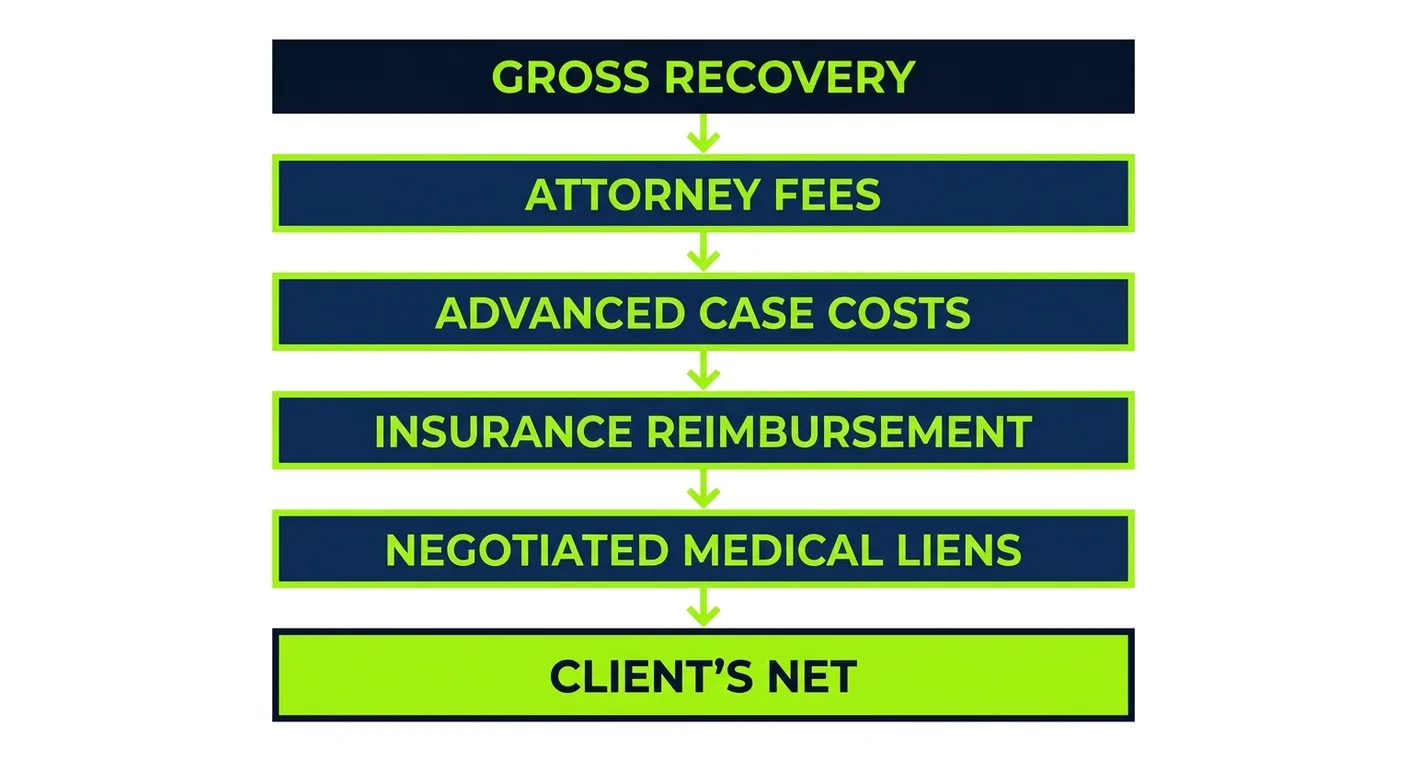
So let me walk it.
Let us make up a number. Say you have a case that resolves for one hundred thousand dollars, because the other side has a one hundred thousand dollar policy, and they pay it. There are a few things that need to be offset or deducted from that hundred thousand.
Here is what that actually looks like. The numbers are made up, but the shape is real.
| Line | Amount |
|---|---|
| Gross settlement | $100,000 |
| Attorney fee, one-third pre-litigation | –$33,333 |
| Case costs advanced by the firm | –$2,000 |
| Health insurer reimbursement, after reduction | –$6,000 |
| Medical provider balances, after negotiation | –$12,000 |
| Net to the client | $46,667 |
Two things to take from that. The first is that the headline number and the check are different, and anyone who tells you otherwise is not doing you any favors.
The second is the line that moves. The fee is fixed by your agreement. The costs are paid at the time of settlement and cannot be reduced. But those last two lines started much higher, and where they land is a function of whether your lawyer fought over them. A client’s net proceeds can be significantly increased by a diligent negotiation of the medical bills and liens, which is why we spend as much time on the bottom of that table as on the top of it.
You are going to have a gross recovery, and then it's offset by a few factors: fees, costs, and most likely medical expenses. Specifically, if it's a medical lien or letter of protection, you want that lien to be negotiated down to a reasonable rate based on historical pricing, and then paid out at the end of your case.
The Lien Reduction Is Where Money Is Won or Lost
Notice the clause in the middle of that answer, because it is the part that carries the most money.
You want that lien negotiated down to a reasonable rate based on historical pricing. Not paid at the amount on the invoice. Negotiated against what that treatment actually settles for in the market, and then paid at the end of the case.
Medical billing in this context is not a fixed price. The same procedure is billed under one number, reimbursed by insurers under a very different number, and resolved in lien negotiation under a third. A firm that pays liens at face value is handing the client's money to providers who never expected to collect at that rate. A firm that negotiates them properly is putting that difference back into the client's net.
This is unglamorous work. It is also, in many cases, worth more to the client than the last few thousand dollars in settlement negotiations.
The Technology Problem Underneath It
There is a second issue with liens that has nothing to do with the amounts, and it is the one clients feel most acutely.
The case concludes. A check is on its way. And then they wait months, understandably, while the lawyer negotiates with anywhere from five to fifty medical providers, one by one, one fax, one email, one text at a time. That is a real valley that lawyers have, where a client goes from grateful and appreciative to asking where their money is. It is not an unfair reaction. They have already waited long enough.
The May Firm has been committed to technological advancement under two principles: that it can increase net proceeds for the client, or that it advances the client experience, meaning it provides a benefit to the client through their journey with us as their lawyers.
Recently, the firm invested in proprietary artificial intelligence, built on its own historical data rather than licensed from the legal software market.
We've developed a product that allows us to utilize every historical lien negotiation that we've ever done with a client. So I can look back at any provider in California or across the United States and know what's been paid, how much we pay on average, and it gives us the ability at the end of the case to get a very accurate estimate of exactly what the client should get.
What that produces is two things. Accuracy, because a client can be told what they should actually net rather than a range. And speed, because the firm can send fifty negotiations immediately, counter, and document every interaction, instead of working the list sequentially over months.
If you are evaluating a firm, it is a fair question to ask: Do you use technology like this, or are you in the process of developing your own?
Common Questions
- How much of my settlement will I actually receive?
- Your gross recovery is reduced by attorney fees, case costs, any reimbursement owed to your health insurer, and outstanding medical bills or liens. What remains is your net. The size of that net depends heavily on how well the liens are negotiated down before they are paid.
- Can medical liens be negotiated down?
- Almost always, yes, and where possible, it should be. Robert May's position is that a lien should be negotiated down to a reasonable rate based on historical pricing rather than paid at the billed amount, and that reduction goes directly into the client's net recovery.
- Why does it take so long to get my settlement check?
- Because liens have to be resolved before funds are disbursed, and a case can involve anywhere from five to fifty providers, each negotiated individually. Firms that handle these sequentially by fax and email take months. Systems that negotiate in parallel significantly compress that window. Which is why we built the Lien Machine, a technology tool, a software based on AI that takes historical data of prices paid previously to providers and is able to simultaneously negotiate numerous bills at one time. Our experience is that once the case is settled, the client deserves to receive their money as quickly as possible. We believe in that so much that we built an entire system off it.
- What questions should I ask a firm about lien negotiation?
- Ask how they determine a reasonable lien amount, whether they negotiate every lien or only large ones, and how long disbursement typically takes after settlement. Robert May suggests asking directly whether the firm has technology supporting that process or is building it.
Chapter Reflection
The headline number is not the number. Fees, costs, insurance reimbursement, and medical liens all sit between the settlement and the check, and the lien line has the most room. Ask any firm you are considering how it handles that step. The answer tells you a great deal about what your net will look like.